
Key Takeaways
- A 2013 study designed to test the claim found no statistically significant link between which side people sleep on and which side of their face shows more wrinkles or sagging.
- Separate biomechanical research published in Aesthetic Surgery Journal found that facial compression during sleep produces a distinct category of wrinkle, different from the ones caused by facial expressions.
- These two findings aren’t contradictory. They’re answering different questions: one about long-term side preference, the other about what happens to skin during a single night of compression.
- In younger skin, compression marks fade minutes after waking. As collagen and elastin decline with age, the same nightly fold gradually stops releasing.
- Switching to back sleeping may offer a modest benefit, but it’s a minor factor compared to sun protection, hydration, and supporting collagen production.
The Claim Everyone Repeats
If you’ve spent any time in skincare forums, you’ve heard the warning: sleep on your side and you’ll etch permanent creases into your cheek. It’s a tidy theory. Press your face into a pillow for a third of your life, and something has to give.
The logic is intuitive enough that it rarely gets questioned. Side sleepers get told to switch to their back, stomach sleepers get warned they’re the worst offenders, and entire product categories, silk pillowcases, “anti-wrinkle” pillows, contoured cushions, have been built around solving a problem that hasn’t been carefully verified. When researchers finally set out to test the claim directly, the results were messier than the theory suggested.
What the First Study Found
A study specifically designed to check whether sleep side predicts facial aging on that side compared people’s preferred sleeping position against wrinkle severity and skin sagging on the left and right sides of their faces. A few things stood out:
- There was no statistically significant association between sleep side and where wrinkles or facial descent showed up.
- Side sleepers weren’t reliably more wrinkled on their sleep side than the other side.
- The correlation people assume exists, between decades of pressure and a lasting, lopsided pattern of aging, didn’t hold up under direct testing.
That’s a real dent in the popular version of the claim. If sleep position caused lasting, side-specific wrinkles the way people assume, this is exactly the kind of study that should have found it.
So Are Sleep Wrinkles Even Real?
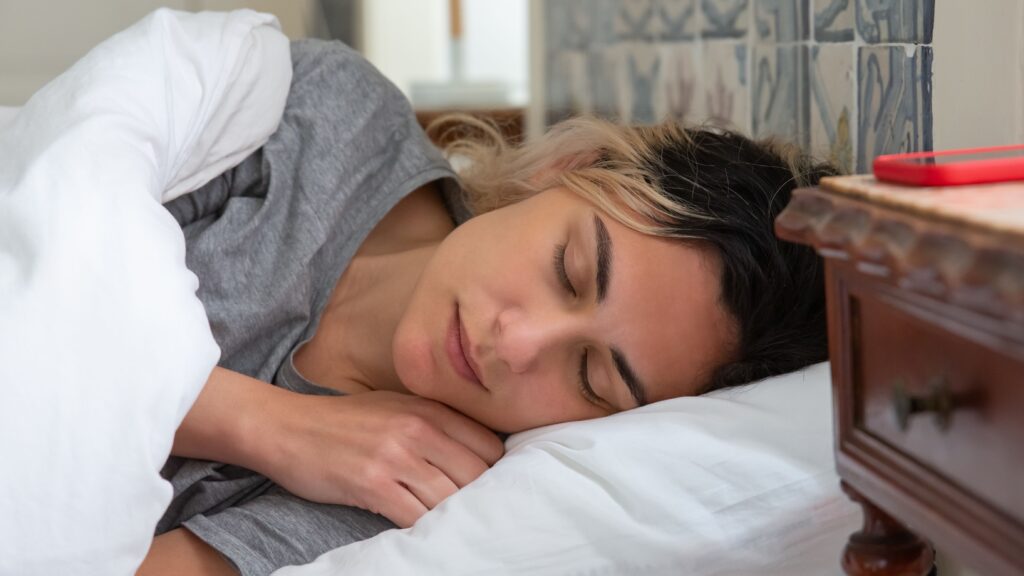
Here’s where it gets more interesting. A separate body of biomechanical research approached the problem from a different angle: not “does sleep side predict long-term facial aging,” but “what physical forces act on skin during sleep, and do they leave a distinct mark?”
That research found the answer is yes. A few key points from this line of work:
- Side and stomach sleeping apply real compression, shear, and tension to facial skin for hours at a stretch.
- These forces create a category of wrinkle that runs in a different direction than expression wrinkles like crow’s feet or frown lines.
- The pattern shows up in fairly predictable places depending on position: cheek and chin creases for side sleepers, forehead and nasolabial folds for those who sleep face-down.
Dermatology coverage of this research describes how side-sleeping compresses skin against the pillow for hours every night, a different mechanism than the muscle-driven creasing behind expression lines.
Reconciling the Contradiction
So which is it? Both, and neither is wrong.
The first study tested whether a lifelong sleep-side preference predicts overall facial aging outcomes, and found no meaningful link. The second research tested something narrower: whether the physical act of compression during sleep produces a measurable, distinct type of crease. It found that it does.
Put together, the answer looks like this: sleep compression leaves a real, distinct mark on skin, but that mark doesn’t reliably translate into the kind of dramatic, side-specific long-term aging the popular claim implies. Other factors likely swamp whatever contribution sleep position makes on its own, including:
- Cumulative sun exposure, which affects both sides of the face fairly evenly for most people.
- Genetics and baseline skin thickness.
- Smoking history and hydration habits.
- Facial expression patterns, which are often more consistent and repetitive than sleep position.
None of these factors are tied to a single side of the face the way sleep pressure is, which may explain why the side-specific effect washes out even though compression itself is real.
Why It Can Turn Permanent With Age
The part of this story that matters most for long-term skin health isn’t the sleep position itself. It’s what happens to the skin’s ability to bounce back.
In younger skin, a crease pressed in overnight by a pillow typically smooths out within minutes of waking. That recovery depends on collagen and elastin, the structural proteins that give skin its ability to stretch and spring back into place. As those proteins decline with age, a process covered in more depth in our post on how skin changes decade by decade, that recovery slows down.
A few things happen as this decline progresses:
- The same nightly fold that used to disappear by breakfast starts to linger a little longer each time.
- Repeated creasing in the same location, night after night, gives the skin a “memory” of that fold.
- Eventually, the crease stops fully releasing at all, even after a full day awake.
This is the same underlying cause behind a lot of visible aging generally, not a special property of sleep wrinkles specifically. It’s less about the pillow and more about the diminishing elasticity described in our breakdown of the core hallmarks of skin aging, where reduced collagen turnover and elastin quality show up across nearly every visible sign of aging skin.
Should You Change How You Sleep?
Given all this, is switching to back sleeping worth the effort? The evidence points to a modest, not dramatic, benefit:
- Eliminating direct compression removes one small contributing factor to how creases set in over time.
- Pillow fabric and design have been studied on a smaller scale, with a few trials suggesting smoother, lower-friction surfaces may reduce crease depth slightly.
- The effect size in these studies is generally small compared to sun exposure and collagen-related decline.
It would be a mistake to treat this as a major anti-aging lever. If back sleeping is comfortable for you, it’s a reasonable low-cost habit to adopt. If it isn’t, losing sleep over your sleep position, literally or figuratively, is probably not a good trade.
Conclusion
Sleep wrinkles are a real, mechanically distinct phenomenon, not a myth. But the specific claim that your preferred sleep side determines which side of your face ages faster doesn’t hold up under direct testing. The more useful takeaway is about elasticity: skin’s ability to recover from nightly compression, like its ability to recover from anything else, depends far more on collagen and elastin health than on which way you happen to be facing when you fall asleep.
Q&A
Is it too late to fix sleep wrinkles once they’ve set in?
Not entirely, but the fix isn’t about switching sleep positions at that point. Once a crease stops fully releasing, it’s a sign of collagen and elastin loss rather than an active compression problem, so addressing it looks more like general skin-elasticity support, retinoids, peptides, sun protection, than avoiding a particular sleep position.
Do silk or satin pillowcases actually help sleep wrinkles?
They may reduce friction slightly compared to cotton, which could ease some of the shear forces involved in sleep-wrinkle formation, but there’s no strong evidence they meaningfully change long-term wrinkle outcomes on their own. They’re a low-risk, low-cost habit, not a proven fix.
If sleep side doesn’t predict facial aging, why do so many people swear their “sleep side” looks different?
Short-term compression marks are real and visible right after waking, which is likely what people are noticing and remembering.