
Key Takeaways
- Testosterone helps maintain skin thickness, collagen density, and elasticity, and its gradual decline with age affects men in ways that parallel, but don’t mirror, estrogen’s role in women
- Men typically start with thicker, more collagen-dense skin, which may delay visible aging but doesn’t prevent it
- Androgens also influence oil production and wound healing, not just firmness
- Research on male-specific skin aging remains comparatively limited, which is part of why this topic deserves more attention
Most content connecting hormones to skin aging focuses on estrogen and menopause, and for good reason, the research base there is substantial. But testosterone plays a documented, structural role in men’s skin that gets far less coverage, despite being just as real.
Let’s a look at what testosterone actually does for skin, how its decline plays out differently than estrogen’s, and what the current research can and can’t tell us yet.
What testosterone actually does for skin
Testosterone, along with other androgens, helps regulate several structural properties of skin. Research has found that declining testosterone levels correlate directly with decreased skin density and reduced elasticity in aging men. This isn’t a minor cosmetic detail. Skin density and elasticity are tied to how well skin holds its shape and resists the sagging and thinning associated with visible aging.
Androgens do more than support thickness, though. They also regulate:
- Sebaceous gland activity, meaning oil production is partly androgen-dependent, which is part of why oilier skin in younger men tends to shift toward drier skin as testosterone declines
- Wound healing, since androgen receptors are present in skin tissue involved in repair processes
- Epidermal barrier function, contributing to how well skin retains moisture and resists irritation
Put together, testosterone functions less like a single “collagen switch” and more like a structural support system that touches multiple aspects of skin health at once.
How the decline actually plays out
Unlike menopause, which represents a relatively abrupt hormonal shift for women, testosterone decline in men is typically gradual. Levels tend to drop by roughly 1 to 2% per year starting around age 30, a slow enough pace that changes often go unnoticed for years before becoming visible.
This gradual pattern creates an interesting contrast with women’s experience. Some research suggests that because men generally start with thicker, more collagen-dense skin (a difference attributed largely to lifetime testosterone exposure), visible aging may appear later than it does for women. But once decline becomes significant, some sources describe the resulting changes as comparatively steeper, since men haven’t necessarily built the same skincare habits or hormonal awareness that women are more often encouraged to develop earlier.
Why male and female skin aging aren’t quite the same story
It’s tempting to map men’s testosterone decline directly onto women’s estrogen decline, but the comparison doesn’t hold up cleanly. Men do have circulating estrogen, and it plays a role in their skin too, just at a much lower baseline than in women. That lower baseline is part of why the collagen decline patterns don’t track identically between sexes, even though both hormones matter for skin structure.
This distinction matters for calibrating expectations. Someone reading our early menopause post might assume men experience an equivalent, single-hormone decline story. The reality is closer to a slower-moving, multi-hormone process that plays out over a longer timeline with different visible markers.
Testosterone replacement therapy and skin
For men using testosterone replacement therapy, whether for age-related decline or other medical reasons, there are documented skin-related considerations worth knowing. A 2025 review examining the dermatological effects of TRT found both potential benefits, related to improved skin density and barrier function, and some adverse effects, including increased oiliness and, in some cases, acne-like breakouts tied to elevated androgen activity.
This is worth stating plainly: TRT is a medical decision made with a physician, based on symptoms and lab values, not a skincare recommendation. Anyone currently on or considering TRT should discuss skin-related effects directly with their prescribing doctor rather than treating this article as guidance for that decision.
What supports skin as testosterone declines
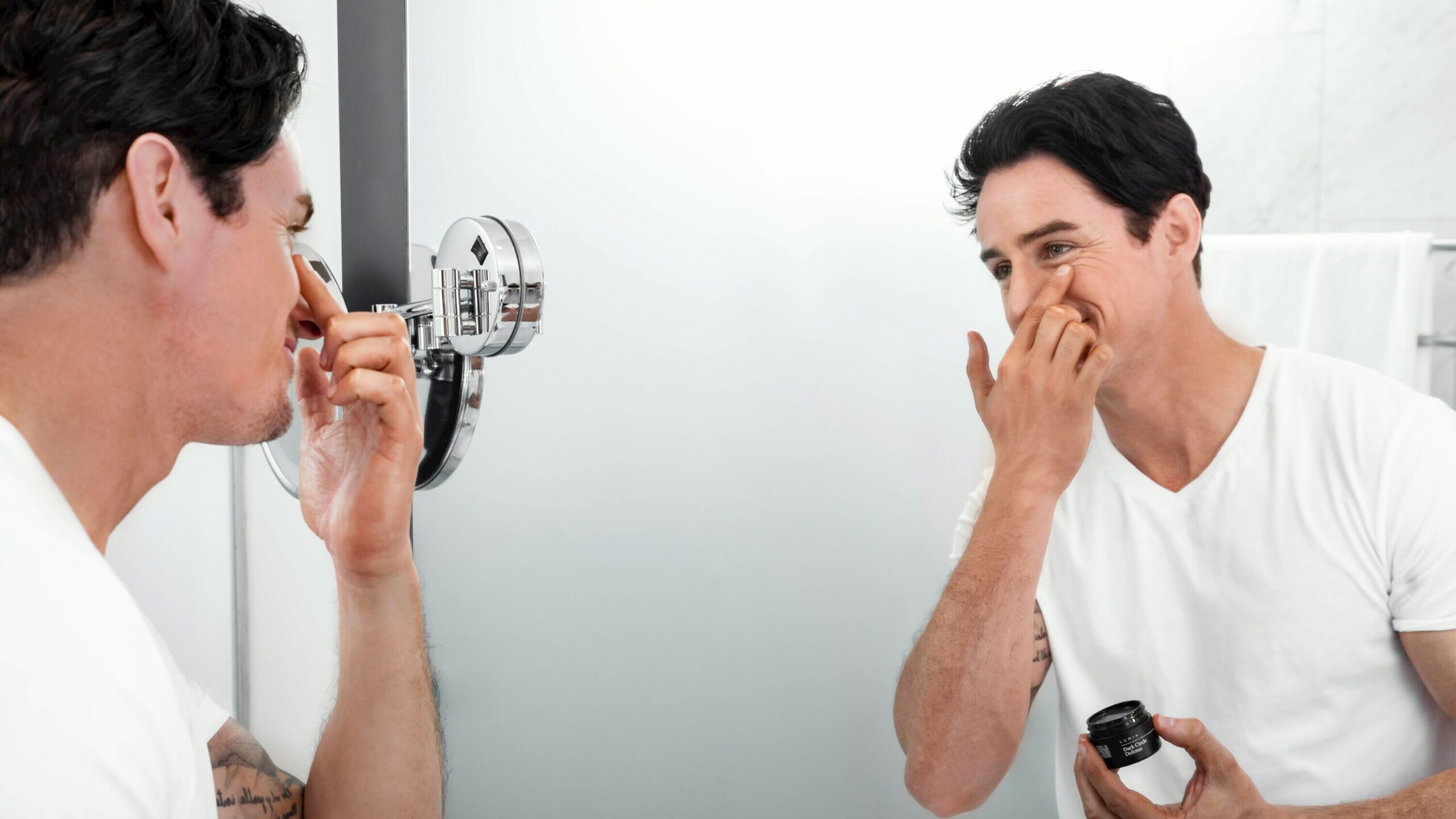
Several habits have reasonable support for helping offset some of the structural changes tied to declining testosterone:
- Resistance training. Strength training supports muscle mass, which provides underlying structural support to skin, and some research links regular exercise to better skin quality markers overall.
- Adequate protein intake. Since skin structure depends heavily on protein-based components like collagen and elastin, sufficient dietary protein gives the body more raw material to work with.
- Consistent sun protection and topical actives. Retinoids and topical vitamin C remain effective regardless of the underlying hormonal cause of collagen decline, since they work directly on skin tissue rather than through the endocrine system.
- Barrier-supportive skincare. As androgen-driven oil production naturally decreases with age, adjusting to a slightly more hydrating routine can help offset the drier skin that often follows.
None of these require a men’s-specific product line. They’re the same fundamentals that support skin health across the board, applied with an understanding of why they matter more as testosterone declines.
Why this topic doesn’t get much attention
It’s worth being direct about a research gap here. Some sources explicitly note that studies on male-specific skin aging patterns remain comparatively limited next to the depth of research available on estrogen and female skin aging. This isn’t because testosterone’s role is less real, it’s more a reflection of where skincare research funding and consumer marketing have historically concentrated.
That gap means some specific questions, like exactly how much visible change a given percentage of testosterone decline produces, don’t yet have precise answers the way certain estrogen-related effects do. It’s a reasonable area to watch as more research emerges, rather than a settled topic.
The bottom line
Testosterone’s role in skin health is real, structural, and backed by legitimate research, even if it hasn’t received the same attention as estrogen’s role in women’s skin aging. Understanding the mechanism doesn’t call for alarm. It calls for the same practical habits that support skin at any hormonal stage, paired with a clearer picture of why those habits matter more as the decades go on.
FAQs
Does declining testosterone cause wrinkles?
Not directly in the way people often think. It contributes to reduced skin density and elasticity over time, which can make existing collagen loss more visible, but it works alongside other aging factors rather than as a sole cause.
Can testosterone replacement therapy improve skin appearance?
Some research points to improved skin density and barrier function with TRT, but it also carries potential skin-related side effects like increased oiliness, and it should be evaluated with a physician based on overall health, not skin goals alone.
Is skincare different for men because of hormones?
To some degree. Higher baseline oil production and thicker skin structure mean routines built primarily around female skin patterns may not translate perfectly, though the core fundamentals (sun protection, topical actives, hydration) apply broadly.
At what age does testosterone-related skin change typically start?
Since decline is gradual from around age 30 onward, most visible changes tend to accumulate quietly and often become more noticeable in the 40s and 50s.
Sources
- “Modulating testosterone pathway: a new strategy to tackle male skin aging.” Clinical interventions in aging, 2012. https://pmc.ncbi.nlm.nih.gov/articles/PMC3459575/
- “Androgens and ageing of the skin.” Current opinion in endocrinology, diabetes, and obesity, 2009. https://pubmed.ncbi.nlm.nih.gov/19390323/
- “Impact of Testosterone on Hair and Skin.” Longdom Open Access. https://www.longdom.org/open-access/impact-of-testosterone-on-hair-and-skin-22400.html
- “Male versus female skin: What dermatologists and cosmeticians should know.” International journal of women’s dermatology, 2018. https://pmc.ncbi.nlm.nih.gov/articles/PMC6116811/
- “Treating Male Skin — Why It’s Different from Women’s.” Venus Treatments. https://www.venustreatments.com/en-gl/blog/treating-male-skin-why-its-different-from-womens/
- “Dermatological adverse effects of testosterone replacement therapy: a scoping review of the literature.” Sexual Medicine Reviews, 2026. https://pubmed.ncbi.nlm.nih.gov/41182303/