Key Takeaways
- LED light therapy, specifically red and near-infrared wavelengths, stimulates fibroblasts to boost collagen and elastin production
- Clinical studies show meaningful but modest results: wrinkle reduction in the 25 to 38% range and measurable elasticity improvement over 8 to 12 weeks
- What it delivers depends heavily on the decade someone starts in, since baseline collagen levels shift significantly with age
- At-home devices are less powerful than professional-grade equipments
LED masks and red light panels have moved from dermatology offices into millions of homes over the past few years, and the question worth asking now is whether the science supports what’s being sold. It does, to a meaningful degree, but what a person can expect from it changes quite a bit depending on where their skin already sits on its aging timeline.
This piece walks through what’s happening under the light, what clinical research shows, and why a person in their 30s and a person in their 50s should probably calibrate their expectations differently.
What’s actually happening under the light
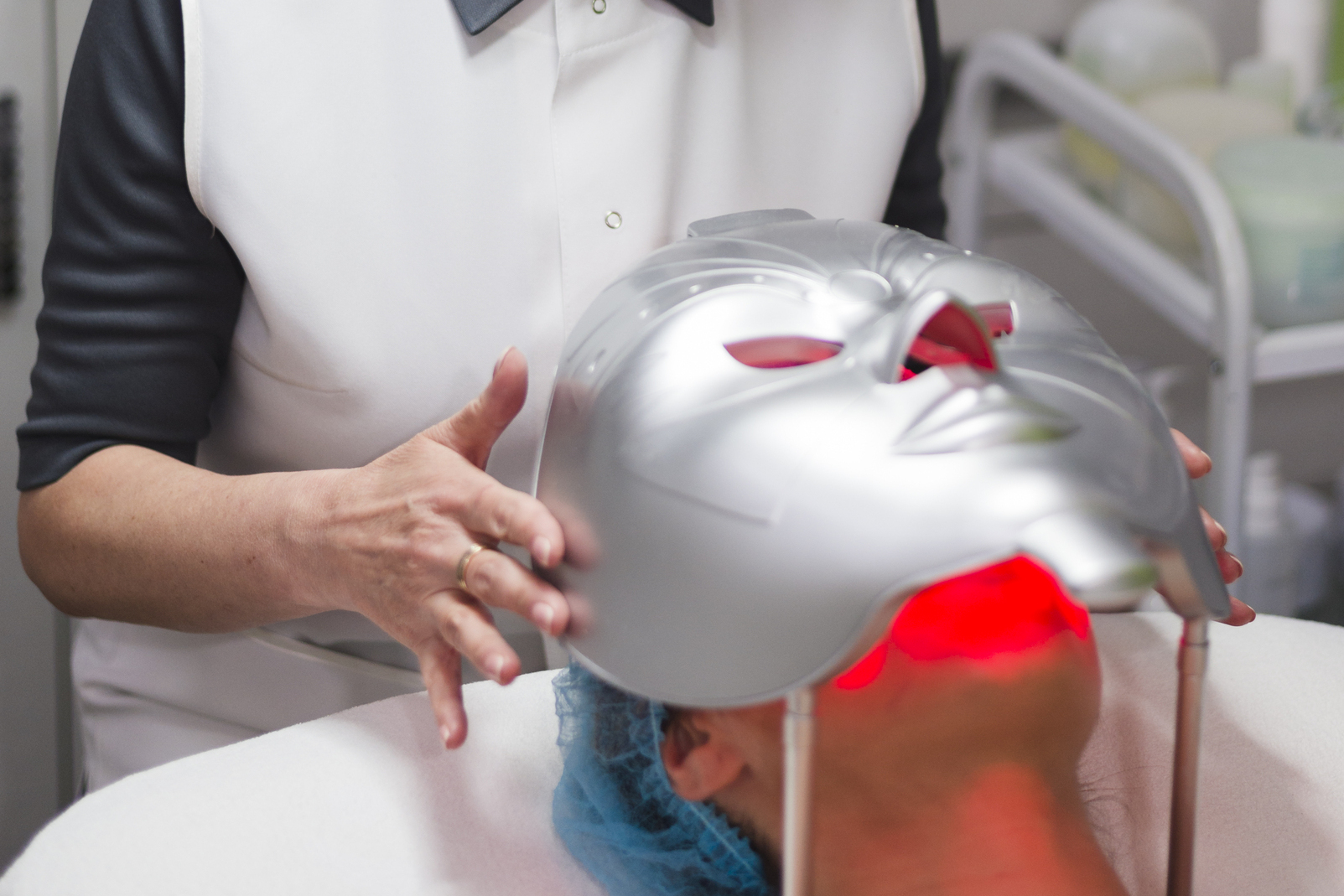
LED light therapy works through a process called photobiomodulation, where specific wavelengths of red and near-infrared light penetrate the skin and get absorbed by mitochondria, the energy-producing structures inside cells. This absorption boosts cellular energy output, which in turn stimulates fibroblasts, the cells responsible for producing collagen and elastin.
There’s also an anti-inflammatory component worth noting. Research has found that red light exposure can help modulate inflammatory cytokine activity in skin tissue, the same category of inflammatory signaling explored in the inflammaging blog, where chronic low-grade inflammation quietly accelerates collagen breakdown over time. LED therapy appears to work on a related pathway, just from a different angle, supporting collagen production while calming some of the inflammatory activity that degrades it.
The research behind the results
Clinical trials on red and near-infrared light therapy have produced some of the more consistent findings in the aesthetic device space.
- A controlled trial using 633nm and 830nm wavelengths found significant improvements in wrinkle appearance and skin elasticity after a full treatment course, with researchers attributing the results to increased collagen synthesis in the dermis.
- Separate clinical data shows wrinkle reduction in the range of 25 to 38% over 8 to 12 week treatment periods, typically requiring consistent sessions several times per week.
- The American Academy of Dermatology also notes that more than 90% of patients in surveyed studies reported some visible improvement, including smoother texture and reduced redness.
Wavelength matters more than most consumer marketing lets on. Shorter wavelengths tend to be more potent but penetrate less deeply, while longer near-infrared wavelengths reach further into tissue with a gentler effect, which is why many devices combine both. The studies producing the strongest results generally used professional-grade equipment with tightly controlled wavelength output, something worth keeping in mind before assuming an at-home mask will match clinical results exactly.
Why the decade you’re starting in changes what to expect
Skin doesn’t age at a flat, constant rate, and neither does its response to stimulation.
In the 30s, collagen decline has typically just begun in earnest, and LED therapy at this stage functions more as maintenance and prevention. There’s more existing collagen infrastructure to support and less damage to reverse, which generally means visible changes come somewhat faster.
In the 40s, active collagen decline picks up pace, a pattern also driven by the hormonal shifts (covered in the HRT and estrogen blog post), particularly as estrogen’s collagen-supportive effects begin to wane. LED therapy at this stage is working against a steeper baseline decline, so consistency becomes more important to see comparable results.
In the 50s and beyond, expectations should shift toward maintenance and slowing further loss rather than expecting dramatic reversal. This isn’t a reason to skip the treatment, research still shows benefit in older skin, but it does mean judging results against a 30-year-old’s outcome sets up disappointment that isn’t really about the device failing.
At-home devices vs. professional treatment
| Factor | At-home devices | Professional treatment |
|---|---|---|
| Power output | Lower, though many are FDA-cleared | Higher, matches most published study parameters |
| Session frequency | Several times weekly, often self-managed | Typically weekly, spaced over 8 to 12 weeks |
| Cost | One-time device purchase, moderate to high | Per-session cost, adds up over a full course |
| Time to visible change | 8 to 12 weeks with consistent use | Often faster due to higher intensity |
| Convenience | High, done at home | Requires scheduling and travel |
For most people, consistency ends up mattering more than raw device power. A lower-intensity mask used correctly several times a week will typically outperform a high-powered treatment used once and then abandoned.
What to look for before buying a device
A few practical checkpoints make the difference between a worthwhile purchase and an expensive drawer item:
- FDA clearance status, which signals the device has met a baseline safety and efficacy standard rather than being an unregulated gadget
- Wavelength specificity, ideally combining red (around 630 to 660nm) and near-infrared (around 810 to 850nm) rather than a single generic light source
- Treatment coverage, since full-face masks tend to deliver more even results than small handheld wands for facial aging concerns
- A realistic use commitment, since most research points to 8 to 12 weeks of consistent sessions before meaningful change shows up
The bottom line
LED light therapy has real clinical backing behind its core mechanism, stimulating collagen production while calming some of the inflammatory activity that breaks it down. What it delivers in practice depends heavily on where a person’s skin already stands in its aging timeline, and treating it as a consistent, long-term habit rather than a quick fix is what separates the people who see results from the people who give up after two weeks.
FAQs
Is LED light therapy safe for daily use?
Most consumer devices are designed for regular use, often several times a week, and are considered low-risk since they use non-thermal, non-UV wavelengths.
How long until results show up?
Most clinical research points to visible change after 8 to 12 weeks of consistent sessions, not immediately.
Can LED therapy replace retinoids or other topical actives?
No. It works through a different mechanism and pairs well with topical actives rather than substituting for them.
Does skin tone affect how well it works?
Photobiomodulation research generally shows benefit across skin tones, since it doesn’t rely on the same pigment-targeting mechanisms as some laser treatments.
Sources
- “Reverse skin aging signs by red light photobiomodulation.” Skin research and technology, 2023. https://pmc.ncbi.nlm.nih.gov/articles/PMC10311288/
- “The Application of Light Emitting Diode (LED) in Cosmetic Dermatology.” Photodermatology, Photoimmunology & Photomedicine, 2025. https://onlinelibrary.wiley.com/doi/full/10.1111/phpp.70041
- “Controlled, randomized, and double-blind clinical trial” on LED phototherapy for skin aging. Medicine, 2023. https://pmc.ncbi.nlm.nih.gov/articles/PMC9902007/
- American Academy of Dermatology. “Is red light therapy right for your skin?” 2026. https://www.aad.org/public/cosmetic/safety/red-light-therapy
- Stanford Medicine. “Red light therapy: What the science says.” 2026. https://med.stanford.edu/news/insights/2025/02/red-light-therapy-skin-hair-medical-clinics.html
- “Optimizing Low-Level Light Therapy for Skin Rejuvenation.” Modern Research in Inflammation, 2025. https://www.scirp.org/journal/paperinformation?paperid=142513
- Hale Health. “Red Light Therapy for Wrinkles: 25–38% Reduction Proven.” 2026. https://thehale.ca/blog/red-light-therapy-for-wrinkles-anti-aging