
Key Takeaways
- Fractional lasers create thousands of microscopic treatment zones, leaving surrounding skin untouched to speed healing.
- Collagen production stays elevated for months after treatment, not just days.
- Laser resurfacing physically removes damaged, pigmented tissue while triggering new, organized collagen underneath.
- Not every photoaging sign responds equally. Pigmentation and redness often need different laser wavelengths than the ones used for wrinkles and texture.
Our previous blog on photoaging explained why sun-driven damage behaves differently than natural aging. Fractional laser resurfacing is one of the treatments built specifically to address that kind of damage, and it has one of the stronger research support bases among cosmetic procedures.
What Fractional Laser Resurfacing Does to Skin
Fractional lasers work by creating thousands of tiny treatment columns across the skin, while leaving the tissue around each one untouched. This is different from older, fully ablative techniques that treated the entire surface at once.
Leaving healthy tissue between each treatment zone matters. It gives skin a faster path to recovery, since undamaged cells nearby can help support and speed up the healing process. This is part of why fractional treatments generally involve less downtime than older, full-surface resurfacing methods.
How This Directly Targets Photoaged Skin
Laser resurfacing doesn’t just stimulate collagen in a general sense. It directly removes some of the damaged tissue that photoaging leaves behind.
Years of UV exposure produce a specific kind of damaged collagen and elastin called solar elastosis. It’s disorganized, clumped, and doesn’t function like healthy collagen. Ablative lasers like CO2 vaporize the outer layers of this damaged tissue directly, then trigger the body to rebuild it with newer, more organized collagen in its place. That’s a different process than simply “boosting collagen.” It’s closer to clearing out damaged material before rebuilding.
The same ablation process also removes the outer, pigmented layer of skin in treated areas. This is part of why laser resurfacing can visibly fade sun spots and uneven pigmentation, not just soften wrinkles. Removing that damaged, pigmented epidermis allows fresher skin to form underneath.
Inside the Repair Process Your Skin Goes Through
Each microscopic injury triggers a wound-healing response underneath the surface. Your skin reacts by ramping up collagen production, and this isn’t a small or short-lived bump.
One clinical study found collagen production climbed to nearly nine times baseline levels around three weeks after treatment, and stayed elevated for at least six months afterward. That long remodeling window is a big part of why results continue to improve well after the initial healing period ends, rather than showing up all at once.
Not Every Sign of Photoaging Responds the Same Way
Fractional CO2 laser isn’t equally effective against every visible sign of sun damage. It performs strongly on texture, fine lines, and overall skin tone, but its results for specific age spots, known as solar lentigines, are more modest, with studies showing improvement in a meaningful but not dramatic range.
This is why dermatologists sometimes combine treatments rather than relying on one laser type for every photoaging concern. Someone dealing with both texture and stubborn pigmentation might need a fractional CO2 session paired with a separate pigment-targeting treatment for the best overall result.
Ablative vs. Non-Ablative: Two Different Approaches
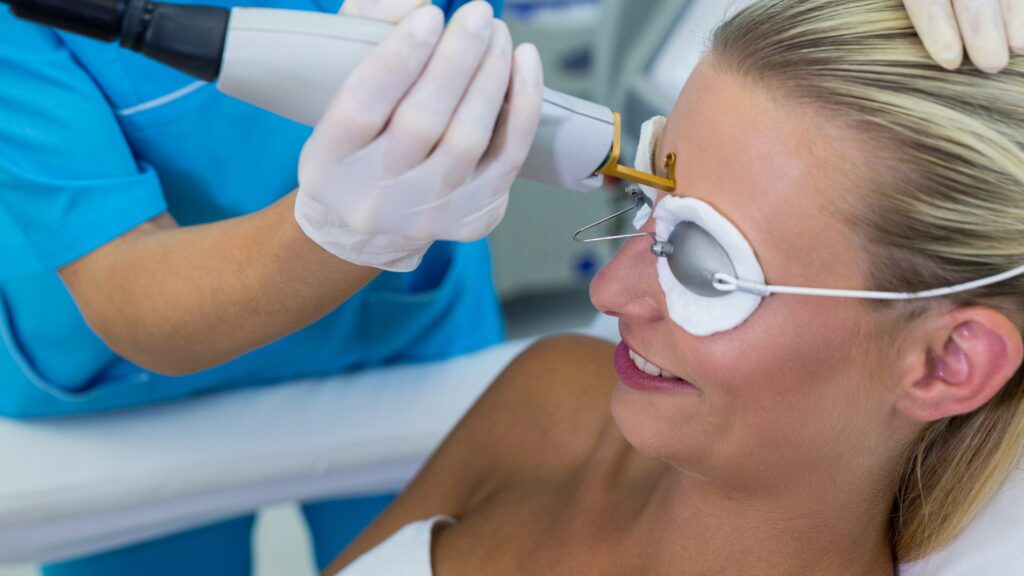
There are two broad categories of fractional lasers:
- Ablative lasers, like CO2 and Erbium:YAG, remove thin layers of skin tissue directly. This produces stronger collagen remodeling and more noticeable improvement, but comes with more downtime and a longer recovery.
- Non-ablative lasers heat the deeper skin layers without removing surface tissue. Recovery is much faster, but results tend to be more gradual and modest compared to ablative options.
Choosing between the two often comes down to how much downtime someone can tolerate versus how dramatic they want the outcome to be. Skin type and the severity of existing sun damage also factor into this decision, which is why a consultation with a dermatologist typically starts by evaluating exactly how much damage is present before recommending one approach over the other.
Comparing CO2 and Erbium Lasers
Within ablative treatments, CO2 and Erbium:YAG lasers are the two most commonly used, and they’ve been compared directly in clinical research.
One study found CO2 laser treatment produced significantly better results than Erbium:YAG, based on both physician evaluation and patient satisfaction. Erbium, on the other hand, tends to come with a gentler recovery and a lower rate of complications, since it targets water in skin cells more precisely and produces less surrounding thermal damage.
In simple terms: CO2 tends to go deeper and deliver more dramatic change, while Erbium tends to be gentler and easier to recover from. The right choice depends on the severity of someone’s sun damage and how much recovery time they can accommodate. Some providers even combine both, using CO2 in areas with deeper damage and Erbium in more delicate zones, to balance results against recovery time.
Why Results Unfold in Two Stages
One detail that often surprises people is that visible tightening shows up almost immediately after treatment, but it isn’t only from new collagen. Part of that early lift comes from swelling and inflammation tied to the healing process itself .
The deeper, longer-lasting improvement comes later, as new collagen continues forming and reorganizing over the following months. This means the skin someone sees a week after treatment isn’t the final outcome. The fuller picture takes shape gradually as the remodeling process continues well past the initial recovery window, which is why most providers recommend waiting at least three to six months before judging the full effect of a single treatment.
Who Sees the Most Noticeable Improvement
Fractional laser resurfacing tends to produce more dramatic results in people dealing primarily with photoaging, meaning sun-driven changes like deep wrinkles, uneven pigmentation, and rough texture, rather than natural chronological aging alone.
This lines up with what we covered previously about the two aging processes working differently. Since photoaging is driven by cumulative UV damage rather than simply the passage of time, it responds well to treatments that directly trigger new collagen formation in already-damaged tissue. People with primarily volume loss or deep structural changes tied to chronological aging often see more modest results from laser treatment alone, and may benefit more from pairing it with other approaches.
A Look at Recovery
Recovery varies quite a bit depending on which type of laser is used.
- Ablative CO2 treatments typically involve one to two weeks of redness, swelling, and peeling before skin looks presentable again
- Erbium:YAG treatments usually involve a shorter recovery window, often under a week
- Non-ablative treatments may cause only mild redness for a day or two, though results build more slowly over time
Sun protection during recovery matters more than usual, since newly treated skin is especially vulnerable to further UV damage while it heals. Most providers recommend a gentle, fragrance-free skincare routine during this period, avoiding active ingredients like retinoids or exfoliating acids until the skin barrier has fully recovered, which can take anywhere from a few days to a couple of weeks depending on the treatment intensity.
Conclusion
Photoaging responds differently than natural aging, and fractional laser resurfacing is one of the more effective ways to address it directly. The visible lift right after treatment is only part of the story. The real change continues building underneath the surface for months, as new collagen slowly reshapes skin that spent years absorbing sun damage.
Q&A
Is laser resurfacing safe for all skin tones?
Certain laser types carry a higher risk of pigmentation changes in darker skin tones, so it’s worth consulting a dermatologist experienced in treating a range of skin tones before choosing a specific device.
How does this compare to at-home devices like microcurrent or LED?
Laser resurfacing produces a stronger, more clinically documented collagen response than most at-home devices, though it also comes with more downtime and requires a professional setting.
Can laser resurfacing be combined with other treatments?
Yes. It’s often paired with topical treatments once skin has healed, since supporting new collagen with ingredients like retinoids or antioxidants can help extend and reinforce the results over time.
Sources
- “A Comparative Study on the Usefulness of Fractional CO2 and Erbium:YAG Lasers.” Advanced biomedical research, 2023. https://pmc.ncbi.nlm.nih.gov/articles/PMC10241645/
- “Fractional Laser Resurfacing Treats Photoaging by Promoting Neocollegenesis” The Journal of clinical and aesthetic dermatology, 2020. https://pmc.ncbi.nlm.nih.gov/articles/PMC7028380/
- “Assessment of Laser Effects on Skin Rejuvenation.” Journal of lasers in medical sciences, 2020. https://pmc.ncbi.nlm.nih.gov/articles/PMC7118506/
- “Connective Tissue Remodeling Induced by Carbon Dioxide Laser Resurfacing of Photodamaged Skin.” JAMA Dermatology, 2004. https://jamanetwork.com/journals/jamadermatology/fullarticle/480863
- “Advancements in Laser Technologies for Skin Rejuvenation.” Journal of Cosmetic Dermatology, 2024. https://onlinelibrary.wiley.com/doi/10.1111/jocd.16514