
The number on your ID is almost irrelevant
You know someone who looks a full decade younger than their age. And you probably know someone who’s the opposite — same year on the birth certificate, totally different skin story. That’s not just good genes or bad luck. It’s biology. And here’s the part that actually matters: it’s modifiable.
There are two ages governing how your skin looks and behaves. The first is your chronological age — the number you say at the doctor’s office. The second is your biological age — the actual functional state of your skin cells, completely independent of what year you were born. The first is fixed. The second is not. And that distinction is the entire foundation of what this site is about.
This article breaks down what biological skin age really means, why it can diverge so dramatically from your actual age, and — most importantly — what you can do to close that gap.
Why chronological age only tells part of the story
Think of chronological age like the mileage on a car. Two vehicles with 100,000 miles can be in completely different shape depending on how they were driven, where they were stored, and how well they were maintained. Chronological age works the same way — it counts time, but it says nothing about what happened during that time.
Skin aging is the product of two overlapping forces: intrinsic aging (what your genes and metabolism are doing from the inside) and extrinsic aging (what your environment and lifestyle have been quietly doing to your cells for decades). Chronological age captures neither. It just keeps counting, like whether you’ve been wearing SPF daily since your twenties or haven’t touched it once.
What exactly is biological skin age?
Biological skin age describes the actual condition of your skin at the cellular level — how well it’s maintaining its structure, renewing itself, and bouncing back from damage. It’s a measure of function, not time.
The real action happens in the dermis — the layer beneath the skin’s surface that most people never think about. This is where your skin’s structural framework lives, built largely out of collagen and elastin fibers produced by cells called fibroblasts. In biologically young skin, fibroblasts are active, responsive, and constantly laying down fresh structural protein. The collagen network is dense, well-organized, and springy. Everything communicates well.
As biological skin age increases, that communication breaks down. Fibroblasts start going quiet. The collagen network becomes thinner and more disorganized. The structural scaffold that gives skin its lift, bounce, and smoothness gradually frays — and wrinkles, sagging, and dullness follow.
Here’s a number worth knowing: collagen production starts declining around age 25 at a rate of roughly 1–1.5% per year. By the time someone is in their 80s, their skin produces just 25% of the collagen it did in youth. For women, there’s an additional accelerant: an average of 30% of skin collagen is lost in the first five years after menopause.
What pushes your biological skin age ahead — or holds it back
This is where it gets personal. Biological skin age isn’t just a genetic lottery — it’s being actively shaped by what you do (and don’t do) every day. Here are the five biggest drivers.
1. UV exposure — the loudest accelerant by far
If there’s one factor that can fast-forward your biological skin age more than anything else, it’s unprotected sun exposure. UV radiation is responsible for up to 90% of visible skin changes — wrinkles, spots, sagging, uneven tone, all of it. It doesn’t just damage the surface. UV breaks down collagen fibers directly, activates enzymes that degrade the skin’s structural scaffold, and causes DNA damage inside skin cells that compounds over years.
The frustrating part? You don’t feel it happening. The damage accumulates silently, and by the time you see it, the cumulative burden is already significant. Someone with decades of sun-soaked summers may have skin that’s biologically a decade or more older than their birth year would suggest.
2. Chronic stress and cortisol
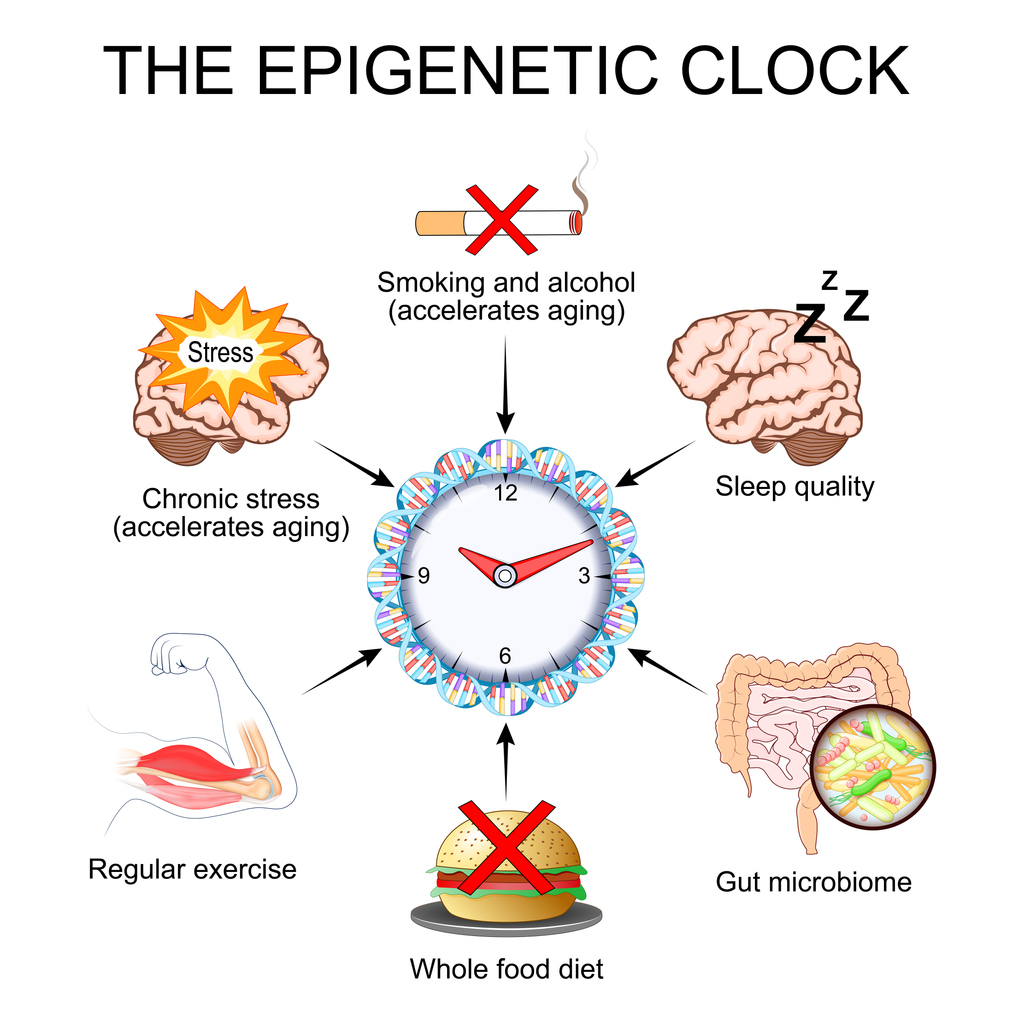
Your skin is not isolated from your nervous system. When you’re chronically stressed, cortisol — the body’s primary stress hormone — stays elevated for extended periods. That sustained elevation drives systemic inflammation, compromises the skin barrier, and interferes with cellular repair. Over time, this slowly but measurably pushes biological skin age forward. Stressed cells age faster. It really is that direct.
3. Poor sleep
Deep, restorative sleep isn’t a luxury — it’s when your skin does most of its repair work. During slow-wave sleep, your body releases growth hormone, which is directly involved in collagen synthesis and cellular renewal. Chronic sleep deprivation reduces that window of repair and elevates inflammatory markers that accelerate cellular aging. The phrase “beauty sleep” turns out to be underselling it.
4. Sugar and glycation
A high-sugar diet quietly accelerates aging through a process called glycation — where sugar molecules latch onto collagen and elastin fibers, making them rigid, brittle, and cross-linked. The resulting compounds (called Advanced Glycation End-products, or AGEs) produce the kind of dull, stiff, wrinkle-prone skin texture that no topical product can fully reverse. We cover this in detail in our next blog — but the short version is that what you eat shows up on your face, at the molecular level.
5. Smoking and air pollution
Smoking is one of the most well-documented external accelerants of biological skin aging in the scientific literature. It floods the skin with free radicals that break down collagen, impair barrier function, and accelerate cellular senescence. Air pollution — particularly particulate matter in urban environments — does something similar, penetrating skin and triggering the same kind of chronic oxidative stress.
The science of measuring your skin’s actual age
For most of history, assessing skin age meant a trained eye looking at the surface — a dermatologist evaluating wrinkle depth, laxity, and pigmentation. That’s still useful, but science has given us something far more precise: tools that measure aging directly at the molecular level.
Epigenetic clocks — your DNA’s own timestamp
Here’s the concept that changed how researchers think about aging: your DNA doesn’t just carry your genetic blueprint — it also carries a record of how you’ve aged. Scattered across your genome are thousands of specific sites where small chemical groups, called methyl groups, attach and detach over time. The patterns of these attachments shift in remarkably predictable ways as you age. Scientists can read those patterns — and calculate, with impressive accuracy, how old your cells actually are.
This is called an epigenetic clock. The first widely validated version, Horvath’s Clock, was published in 2013 using data from over 8,000 samples across 51 tissue types. Its median error? Less than four years. Think about what that means: your DNA is keeping a more accurate record of your biological age than most blood panels can.
Since then, second-generation clocks like GrimAge and PhenoAge have gone even further — they don’t just estimate age, they predict biological decline and disease risk. And for skin specifically, researchers have developed skin-targeted clocks: OneSkin’s MolClock, built from over 500 human skin samples and more than 2,000 methylation markers, can assess the biological age of your skin tissue directly — not just your body overall.
These tools aren’t just academic novelties. They’re allowing scientists to answer the question we actually care about: does this treatment change biological skin age at the cellular level?
Other ways to measure what’s happening under the surface
Epigenetic clocks are not the only measure. Other useful biomarkers include:
- Telomere length — the protective caps on your chromosomes that shorten as cells age and replicate
- Inflammatory markers like CRP and IL-6, which, when chronically elevated, accelerate cellular aging across the body
- Dermal collagen density, measurable by high-frequency skin ultrasound
- Transepidermal water loss (TEWL), a measure of how well your skin barrier is functioning — it worsens measurably with biological aging
No single marker tells the whole story. But taken together, they’re painting a picture that’s increasingly actionable.
The part worth getting excited about: this can be reversed
Here’s where it gets genuinely hopeful. A 2023 case series published in the peer-reviewed journal Aging enrolled women aged 46–65 in an 8-week diet and lifestyle program — focused on methylation-supporting foods (leafy greens, eggs, cruciferous vegetables), consistent exercise, 7+ hours of sleep, and structured stress reduction. The result: an average biological age reduction of 4.6 years, measured by epigenetic clock. The most significant single result in the group: 11 years of biological age reversed, in 8 weeks.
That’s not a cream promising “younger-looking skin.” That’s a measurable shift in what the DNA itself is recording.
The takeaway isn’t that you need to follow an exact program. It’s that biological skin age responds to the inputs you give it — from the surface down to the cellular level. The right combination of lifestyle habits, targeted ingredients, and evidence-based treatments can move that number in your favor. Everything on this site is built around figuring out what actually makes that happen.
A two-age framework for smarter skincare
Understanding the gap between chronological and biological skin age reframes the entire goal of anti-aging skincare. The question stops being “how do I cover up the signs of aging?” and becomes “how do I change the underlying biology?”
That means addressing four overlapping layers:
- Extrinsic accelerants — reducing UV exposure, pollution, and lifestyle habits that push biological age forward
- Topical interventions — ingredients with real clinical evidence for stimulating cellular renewal and collagen production
- Internal and lifestyle factors — sleep quality, diet, stress load, hormonal health
- Professional and device-based treatments — tools that intervene at the dermal level to restore structural integrity
These work best together — not as separate product categories, but as a coordinated strategy aimed at the same goal: shifting your biological skin age.
Conclusion
Your chronological age is fixed. Your biological skin age isn’t — and the gap between the two is larger, and more controllable, than most people realize. UV exposure, sleep, stress, diet, and cellular repair capacity are all active variables that push that number up or down. The science of measuring biological age has advanced dramatically, with epigenetic clocks now tracking real change at the molecular level. And the evidence that this age can be meaningfully reversed, through the right combination of lifestyle and targeted intervention, is more compelling than ever.
Sources
- “Biological vs. Chronological Skin Aging.” https://myskin-mallorca.com/knowledge-hub/epigenetics-skin-longevity/biological-vs-chronological-skin-aging/
- “A Biological Clock to Measure Skin’s Anti-Ageing Interventions.” https://mitrabio.tech/resources/which-biological-clock-to-use-for-skins-anti-ageing-interventions/
- “Influences on Skin and Intrinsic Aging: Biological, Environmental, and Lifestyle.” https://pubmed.ncbi.nlm.nih.gov/39604792/
- “How OS-01 Can Help Collagen Levels by Age.” https://www.oneskin.co/blogs/reference-lab/how-to-maintain-healthy-collagen-as-you-age
- “A collagen amino acid composition supplementation reduces biological age in humans.” https://www.nature.com/articles/s41514-025-00280-7
- “Photoaging: What You Need to Know About the Other Kind of Aging.” https://www.skincancer.org/blog/photoaging-what-you-need-to-know/
- “The Impact of Environmental Factors on Skin Aging.” https://skinscienceinstitute.com/the-impact-of-environmental-factors-on-skin-aging/
- “How Sun, Stress, and Sleep Affect Skin Aging Over Time.” https://www.mountcastlemedicalspa.com/blog/how-sun-stress-and-sleep-affect-skin-aging-over-time/
- “Potential reversal of biological age in women following an 8-week methylation-supportive diet and lifestyle program: a case series.” https://pmc.ncbi.nlm.nih.gov/articles/PMC10085584/