Your skincare routine may be missing one key variable: less sugar
You’ve got the retinol, the vitamin C, maybe a peptide serum. And yet something still feels off — a dullness, a stiffness, a subtle loss of bounce that no product seems to fix. Here’s a likely culprit that rarely shows up on ingredient labels: glycation.
It’s a slow, quiet biochemical process driven largely by the sugar in your diet — and it’s actively destroying the collagen and elastin that hold your face together. Most people have never heard of it. But once you understand what it’s doing beneath your skin, you won’t be able to unknow it.
What is glycation — in plain English
Glycation happens when excess sugar molecules in your bloodstream bond to proteins — specifically, the collagen and elastin that form your skin’s structural scaffolding. This isn’t a controlled process; it’s a messy, spontaneous chemical reaction that accelerates whenever blood sugar is elevated.
The products of this reaction are called Advanced Glycation End-products — or, in one of biochemistry’s more fitting acronyms, AGEs.
Here’s what makes this particularly frustrating: collagen in the skin has a half-life of roughly 10–15 years, meaning individual fibers sit in your dermis for over a decade before being replaced. That means those fibers have years of ongoing exposure to circulating sugar. Every year, more AGEs accumulate. The damage compounds silently until the day you look in the mirror and wonder what happened.
What AGEs actually do to your skin
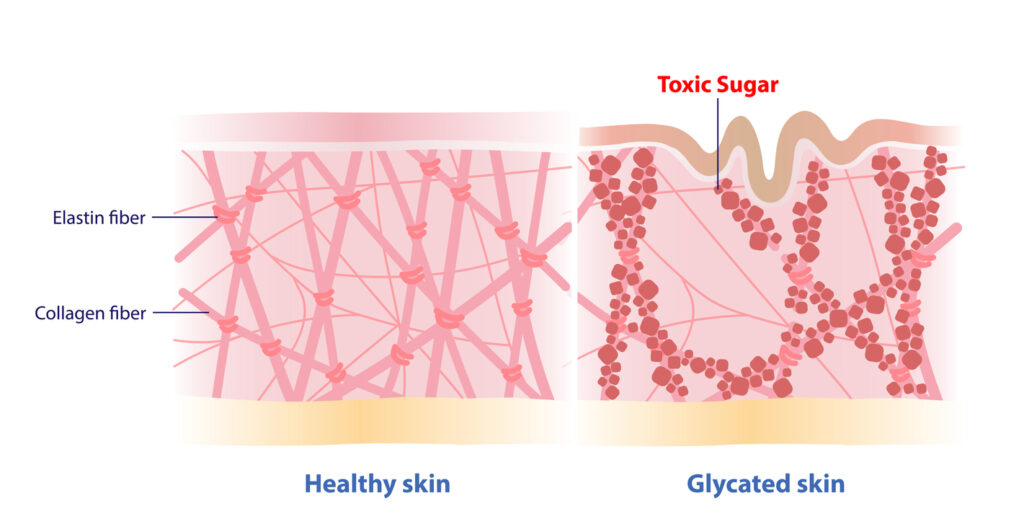
Picture a bundle of fresh pasta — pliable, smooth, slightly bouncy. That’s young collagen. Now imagine it dried out and stiffened into a brittle, tangled mess. That’s what glycation does.
AGEs create abnormal cross-links between collagen fibers — essentially gluing them together so they can no longer flex, rebuild, or communicate properly with skin cells. At the surface, the results are familiar:
- Fine lines and wrinkles from loss of structural flexibility
- Sagging and laxity as cross-linked collagen loses its spring
- Dullness and sallowness — AGEs carry a brownish-yellow tint that shifts the complexion toward tired and uneven
- Slower healing and reduced skin resilience
AGEs also trigger a cascade of inflammation and oxidative stress that damages surrounding skin cells — feeding a cycle of accelerated degradation.
The honest truth: can glycation be reversed?
Here’s where a lot of beauty content gets it wrong. Once a collagen fiber is cross-linked by AGEs, it cannot be un-cross-linked. No cream or serum breaks down existing AGEs in the dermis. The damage in existing collagen is, for practical purposes, permanent — until that fiber eventually turns over (which, given the 10–15 year half-life, takes time).
What can be done:
- Stop new damage from forming — by reducing blood sugar spikes and protecting against UV
- Support fresh collagen synthesis — so new, undamaged fibers gradually replace glycated ones
- Use topical ingredients that intercept the glycation reaction — more on those below
Think of it like stopping a slow leak. You can’t instantly undo the water damage already done, but stopping the leak and letting the structure rebuild makes a real, measurable difference over time.
What to do: the anti-glycation strategy
Manage your blood sugar — the dietary foundation

No serum compensates for a chronically high-glucose bloodstream. The most impactful thing you can do is reduce blood sugar spikes.
- Eat protein and fat before carbohydrates at meals to flatten your glucose curve
- Choose low-glycemic carbohydrates: leafy greens, legumes, whole oats, whole fruits (not juice)
- Cut added sugars and refined starches — the hidden sources in sauces, dressings, and packaged foods add up fast
- Change how you cook: steaming, poaching, and boiling produce far fewer dietary AGEs than grilling, frying, or broiling. Grilled chicken contains roughly four times more dietary AGEs than poached chicken
- Load up on antioxidant-rich foods — berries, green tea, leafy greens, and fatty fish — that counter the oxidative stress AGEs trigger
The topical toolkit
Carnosine is the standout ingredient. It acts as a glycation interceptor — binding to reactive sugar molecules before they reach your collagen. A 2018 study in Skin Pharmacology and Physiology found a carnosine-containing cream reduced AGE levels in human skin by 64–150% depending on formulation. That’s the strongest topical anti-glycation evidence in current literature.
Alpha-lipoic acid (ALA) inhibits AGE formation by neutralizing the reactive compounds that initiate glycation, while also regenerating vitamin C and glutathione.
Niacinamide reduces the inflammation driven by AGE accumulation and supports barrier integrity.
Vitamin C limits the oxidative conditions that accelerate glycation and fuels fresh collagen synthesis to replace damaged fibers.
Retinoids accelerate cell turnover — speeding up the process by which AGE-damaged collagen is broken down and replaced.
Daily SPF is non-negotiable: UV radiation directly accelerates glycation reactions in the skin, compounding sun damage and sugar damage simultaneously.
Conclusion
Glycation is one of the most significant and underappreciated drivers of premature skin aging — driven largely by what you eat, compounding quietly for years. Existing AGE damage in collagen is genuinely difficult to undo, but stopping new damage, supporting fresh collagen production, and using evidence-backed actives like carnosine and alpha-lipoic acid can meaningfully slow the process. Your skincare routine matters — and so does what’s on your plate.
Sources
- “An in vitro approach to the chronological aging of skin by glycation of the collagen.” https://pubmed.ncbi.nlm.nih.gov/16037275/
- “Advanced Glycation End Products in the Skin: Molecular Mechanisms, Methods of Measurement, and Inhibitory Pathways.” https://pmc.ncbi.nlm.nih.gov/articles/PMC9131003/
- “Effect of collagen turnover on the accumulation of advanced glycation end products.” https://pubmed.ncbi.nlm.nih.gov/10976109/
- “The effects of advanced glycation end-products on skin and implications for treatment.” https://onlinelibrary.wiley.com/doi/full/10.1111/exd.15065
- “Novel Facial Cream Containing Carnosine Inhibits Formation of Advanced Glycation End-Products in Human Skin.” https://pubmed.ncbi.nlm.nih.gov/30199874/
- “Alpha-Lipoic Acid Treatment Reduces the Levels of Advanced End Glycation Products.” https://pubmed.ncbi.nlm.nih.gov/40002851/
- “Can an anti-glycation skincare routine really slow ageing?” https://www.harpersbazaar.in/beauty/story/can-your-anti-glycation-skincare-routine-really-slow-ageing-1114977-2024-11-13
- “Glycation and Skin Aging: 11 Tips to Avoid Sugar-Induced Aging.” https://www.annmariegianni.com/10-tips-to-avoid-sugar-induced-aging/